
Published Research
A PhD, four papers, and a placebo-controlled trial into one of medicine's harder problems.
Fibromyalgia, medicinal cannabis and the endocannabinoid system. What I set out to find, what the evidence actually supports, and what all of it changed about the way I practise.
The Motivation
Why a naturopath went and did a PhD
Because I kept meeting people who had run out of options inside the usual system.
Fibromyalgia affects roughly 2.7% of people worldwide. It causes persistent widespread pain, usually alongside fatigue, unrefreshing sleep, headaches, low mood and gut symptoms. There is no cure. The available drug treatments help some people, and the side effects are a real problem for others.
Meanwhile, patients were telling me that cannabis helped. Not vaguely, not once, but consistently and specifically. When I went looking for the evidence behind that, there was almost nothing. A handful of small studies. Strong opinions in both directions, and not much data underneath them.
That gap bothered me. So I went and worked in it.
The Research Question
What I set out to understand
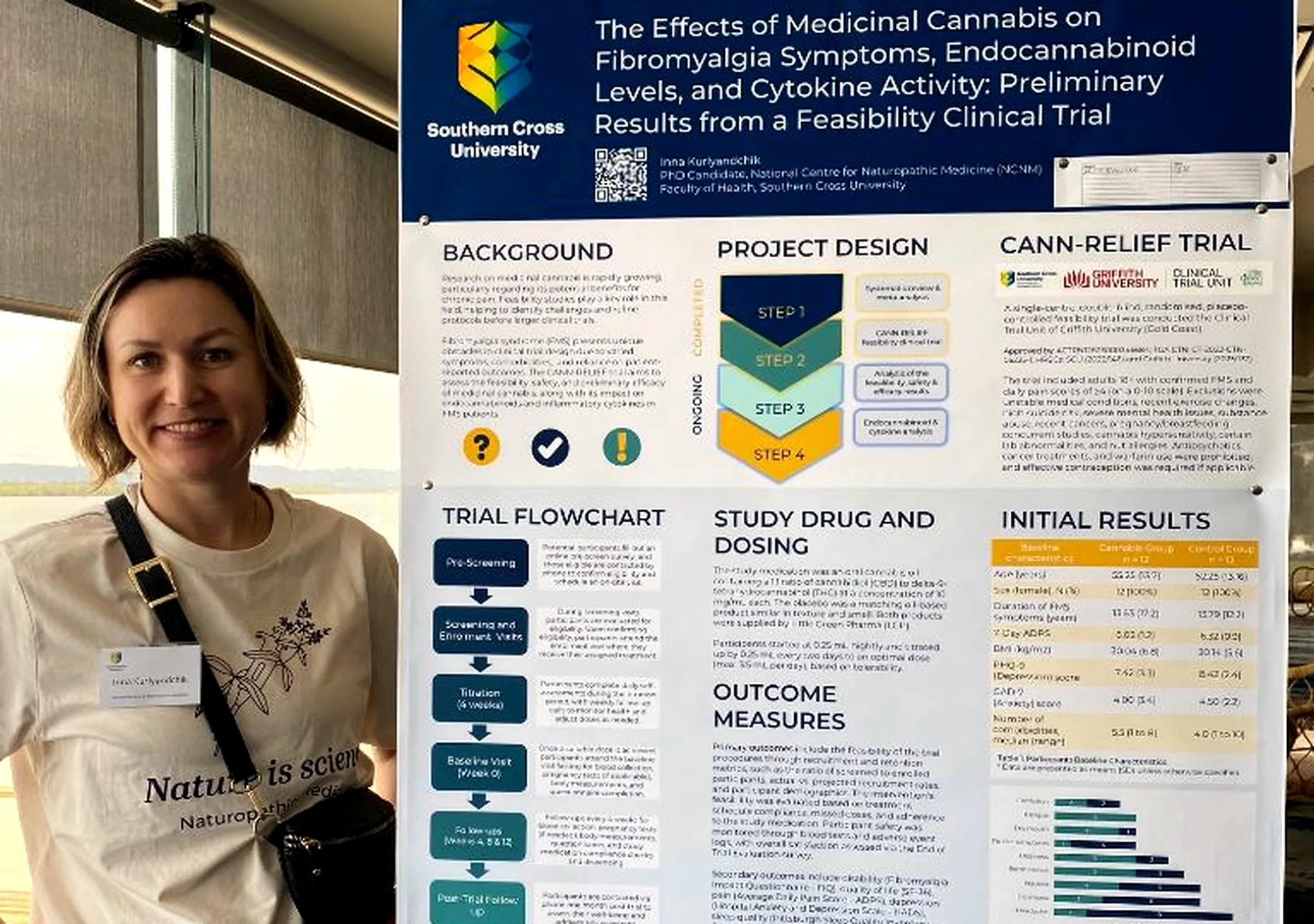
In 2020 I began a PhD at the National Centre for Naturopathic Medicine, Southern Cross University. The question, put simply:
Is the endocannabinoid system disturbed in people with fibromyalgia, and if it is, can medicinal cannabis safely help?
The endocannabinoid system is one of the body's core regulatory networks. It is involved in pain signalling, sleep, mood, appetite, immune function and the stress response: one of the systems the body uses to keep those in balance. If that system is dysregulated in fibromyalgia, it would help explain why fibromyalgia looks the way it does: not one broken part, but an entire regulatory system running badly.
It would also help explain why some patients respond to something that acts on it.
The Body of Work
Four pieces of work, one question
-
92%
Participant retention
-
100%
Adherence ≥90% doses
-
0
Serious adverse events
-
What does the existing evidence actually say?
Journal of Alternative and Complementary Medicine, 2021I began with a systematic review of everything published on the safety and effectiveness of medicinal cannabis in fibromyalgia. The honest answer was: promising, and nowhere near good enough. Small studies. Inconsistent outcome measures. Not enough placebo control.
-
Is the endocannabinoid system actually different in these patients?
PAIN Reports, 2022Next, a systematic review and meta-analysis, pooling every available measurement of endocannabinoids and related compounds in the blood and tissue of people with fibromyalgia and chronic widespread pain.
We found consistent differences. Several endocannabinoid-related compounds were elevated compared with healthy controls, which supports the idea that this system is dysregulated in these conditions rather than functioning normally.
That matters more than it might sound. It moves fibromyalgia a step further from “we cannot find anything wrong with you” and a step closer to “here is a system that appears to be behaving differently.”
-
Then we ran the pilot trial
Pain Research and Management, 2026We conducted a randomised, double-blind, placebo-controlled pilot trial of a balanced 1:1 THC/CBD cannabis oil in adults with fibromyalgia, under ethics approval from Southern Cross University and Griffith University.
We measured pain, sleep, fatigue, function and quality of life using validated instruments, alongside safety monitoring and individualised dose titration. Nobody, including me, knew who was receiving the cannabis oil and who was receiving the placebo until the data were locked.
Twenty-four adults with fibromyalgia, all women in this sample, were randomised, and 22 completed the trial. Recruitment did not reach the planned target, largely because of travel demands and concerns about THC driving laws, but retention was high at 91.7%, and adherence was excellent, with every participant taking at least 90% of prescribed doses. In this small sample, the oil appeared generally well tolerated: most adverse events were mild, and no serious adverse events were observed.
Among participants with valid symptom data, secondary outcomes suggested a preliminary signal for pain, sleep and overall fibromyalgia impact. At week 12, 70% of the cannabis group reported at least 30% pain reduction compared with 40% of placebo, and clinically meaningful FIQR improvement occurred in 40% versus 10%. But fatigue and mood outcomes were less clear, the study was not powered to prove efficacy, and blinding was imperfect.
-
And a companion paper on the mechanism
Cannabis and Cannabinoid Research, 2026A companion mechanistic paper asked a different question: if symptoms changed, could we see corresponding changes in blood markers related to the endocannabinoid system?
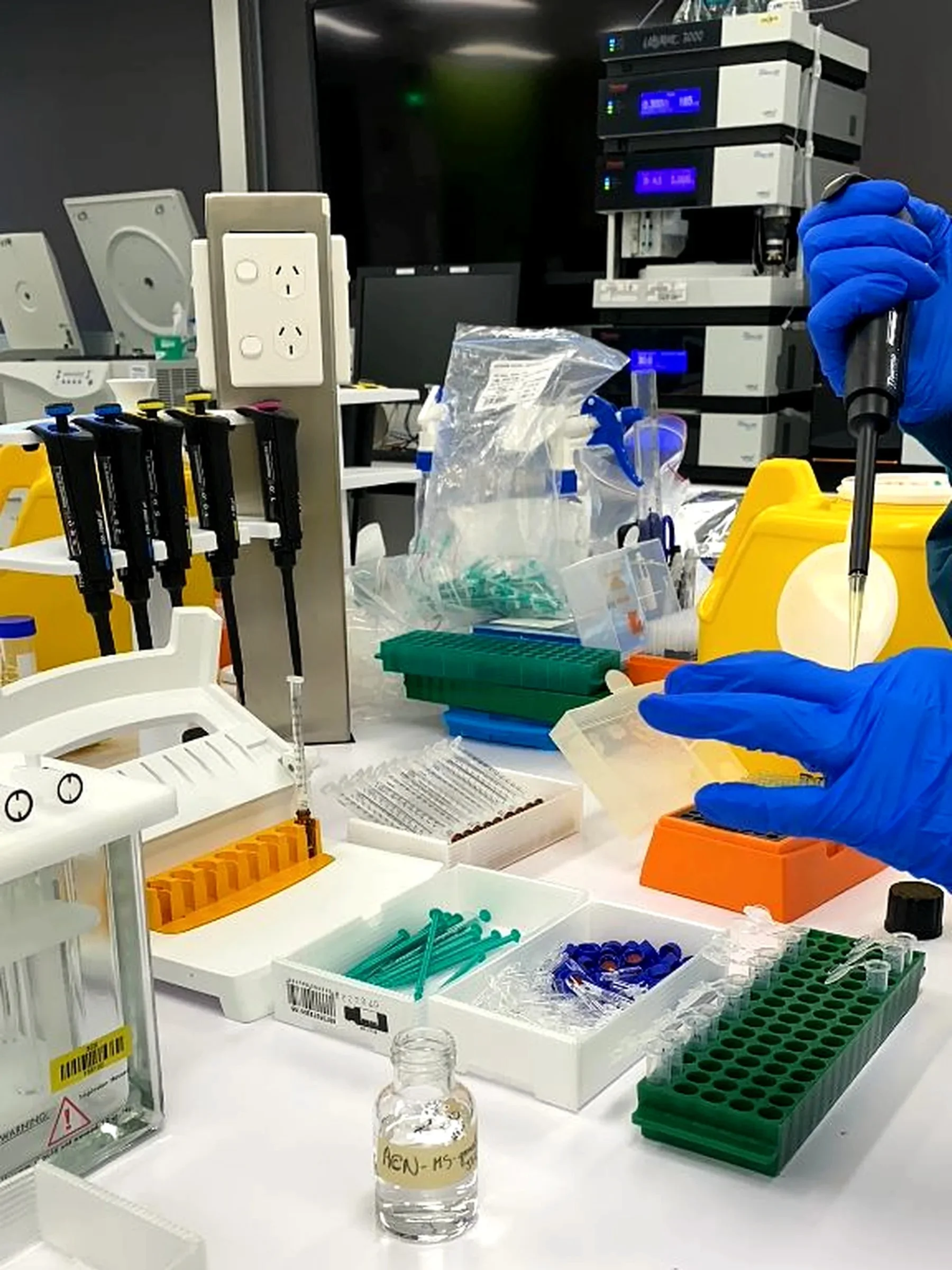
This analysis measured fasting morning blood levels of three endocannabinoid-related N-acylethanolamines, PEA, OEA and SEA, over the 16-week dosing period. These markers remained stable in both the cannabis and placebo groups, with no significant treatment-related changes. AEA and 2-AG could not be reliably measured with the assay used and were excluded from analysis.
In plain language, the preliminary symptom signals seen in the pilot trial were not mirrored by sustained changes in these peripheral blood markers. That suggests these particular markers may have limited use for monitoring response to this formulation, and that future research may need to look more closely at timing, more sensitive assays and central nervous system mechanisms.
-
The thesis
Read the thesisAll of it came together as The role of the endocannabinoid system and medicinal cannabis in fibromyalgia syndrome, a Doctor of Philosophy in Health Science from Southern Cross University.
It is freely available to read in full.
Honest Caveats
What this does and does not mean
This section matters more than the rest, so I have kept it short.
I am not a medicinal cannabis prescriber.
In Australia, medicinal cannabis is a prescription-only medicine, and naturopaths cannot prescribe it. Completing a PhD on the subject does not change that. If it is something you want to explore, that conversation belongs with an authorised prescriber, and I am glad to talk you through what the evidence does and does not currently support so that you can have that conversation well informed.
A pilot trial is a beginning, not a verdict.
Ours was designed to establish feasibility and safety and to look for a preliminary signal. It was not large enough to settle the question. Anyone telling you that cannabis definitively cures fibromyalgia is ahead of the evidence. So is anyone telling you it definitively does not.
The trial was small and not diverse enough to answer every question.
All participants who enrolled were women, which occurred incidentally rather than by design, and the study was conducted at a single site. The symptom outcomes were secondary and exploratory, not the primary purpose of the trial. Like many THC-containing trials, blinding was also difficult: 75% of participants in both groups correctly guessed their allocation. That does not make the findings meaningless, but it is one reason they should be treated as a signal for larger trials rather than proof.
Good design exists to protect you from me.
The trial was randomised, placebo-controlled and double-blinded precisely so that the result would be produced by the method rather than by anybody's hopes, mine included. I hold my clinical practice to the same standard as best I can.
Disclosure
My PhD scholarship was jointly funded by Southern Cross University and Little Green Pharma Ltd. Little Green Pharma supplied the cannabis oil and matched placebo used in the trial, but had no role in the study design, conduct, data collection, management, analysis, interpretation, manuscript preparation, review, approval or decision to publish. Full disclosures are listed in the published papers.
Clinical Translation
What five years of research changed about how I practise
This is the part that matters if you are a patient rather than a researcher.
I do not treat fibromyalgia as a mystery. There is real, describable biology involved, even if not all of it is settled. The endocannabinoid system, the stress axis, sleep architecture, gut function and immune signalling are all in play, and several of them can be supported.
I take pain reports at face value. Central sensitisation is real and measurable. If your pain is out of proportion to any tissue damage anyone can find, that is information, not a character flaw.
I read the literature before I read the label. Conducting a systematic review is an education in how much confident marketing sits on top of how little data. I would rather tell you honestly that the evidence for something is thin than sell you a certainty I do not have.
I have seen what a placebo response looks like in a trial, and I take it seriously. A meaningful proportion of people improve on placebo in chronic pain trials, often around a third. That is not nothing, and it is not deception. It tells us something true about how much of pain is shaped by expectation, context and the experience of being properly listened to. I build that into how I practise rather than pretending it away.
I still support people with fibromyalgia, using nutritional, herbal and lifestyle interventions that do have evidence behind them, and by helping them navigate the parts of their care that sit outside my scope.
Published Work
Peer-reviewed articles
-
View paper
Randomised Controlled Trial
Kurlyandchik I, Tiralongo E, Lauche R, Tracey G, Ng J, Schloss J. Feasibility, safety and preliminary efficacy of 1:1 THC:CBD cannabis oil for fibromyalgia symptoms: results from a randomised, double-blind, placebo-controlled pilot trial. Pain Research and Management. 2026. doi:10.1155/prm/7311235
-
View paper
Mechanistic Analysis
Kurlyandchik I, Van Crugten J, Lauche R, Tiralongo E, Schloss J. Oral medicinal cannabis does not alter plasma levels of endocannabinoid-related N-acylethanolamines in fibromyalgia patients: findings from a randomised placebo-controlled trial. Cannabis and Cannabinoid Research. 2026. doi:10.1177/25785125261469541
-
View paper
Systematic Review and Meta-Analysis
Kurlyandchik I, Lauche R, Tiralongo E, Warne LN, Schloss J. Plasma and interstitial levels of endocannabinoids and N-acylethanolamines in patients with chronic widespread pain and fibromyalgia: a systematic review and meta-analysis. PAIN Reports. 2022;7(6):e1045. doi:10.1097/PR9.0000000000001045
-
View paper
Systematic Review
Kurlyandchik I, Tiralongo E, Schloss J. Safety and efficacy of medicinal cannabis in the treatment of fibromyalgia: a systematic review. Journal of Alternative and Complementary Medicine. 2021;27(3):198-213. doi:10.1089/acm.2020.0331
-
View thesis
PhD Thesis
Kurlyandchik I. The role of the endocannabinoid system and medicinal cannabis in fibromyalgia syndrome. PhD thesis, Southern Cross University, 2026. doi:10.25918/thesis.583
Living with fibromyalgia or chronic pain?
I have spent more than five years studying this condition, and considerably longer treating it. If you are looking for someone who takes the condition seriously and knows the evidence, come and talk to me.
Book a consultation Or read my articles on fibromyalgia